A very FUN Question #3 (of 5) for you.

Thank you once again for your awesome comments and for sharing my posts on your social media sites. So today we have question 3 for you. Let’s review the first two questions.

  1. If you could make a 30 second speech to the entire world, what would you say?
  2. If you were at heaven’s gates, and God asked you, “Why should I let you in?”, what would you say?

I continue to welcome your comments on this question and look forward to what you have to say about the other questions, as well. So here it is. Today’s question has 3 parts:

3. If your life was a novel, what genre would it fit into, what would be the title and how would your story end?

Looking forward to some great answers to this one!

Jennifer Mott

Question #2 (of 5) for you?

I had some terrific responses to yesterdays question. Thank you to those who commented and shared it through your social media sites. Let’s review. Here is yesterdays question.

  1. If you could make a 30 second speech to the entire world, what would you say?

I continue to welcome your comments on this question and look forward to what you have to say about the other questions, as well. So here it is. Today’s question is:

2. If you were at heaven’s gates, and God asked you, “Why should I let you in?”, what would you say?

So, what say you?

Jennifer Mott

My 5 Questions for you… 1 at a time.

question

I have 5 questions for you, but will ask one a day for 5 days. They are designed to make you take 5 minutes (maybe more) out of your business, crazy day to think, reflect and share. Some questions you may like and some you may not. It’s okay if you don’t like one of my questions, I can handle it. If you have a question for everyone, please feel free to include it in your comment on this topic.

I look forward to reading your comments. So, I will get right to the first question.

  1. If you could make a 30 second speech to the entire world, what would you say?

So? What say you?

Jennifer Mott

Here’s a cactus. Tell me about it.

Image An applicant to the Biological Sciences program at Oxford University sits down in front of the Tutor (interviewer) and is given a cactus in a pot and a close-up photo of its surface. The Tutor states, “Here’s a cactus. Tell me about it.” What would you say? Would you talk about the large sharp spines, surrounded by lots of small hair-like spines? Would you address the problems faced by plants and animals in dry habitats? When I first saw the question, it made me think about how we see things. What do we really see when we take a hard look at something?

It’s no big secret to those who know me that I have a 6 year old black lab that is my absolute best friend and my world revolves around her. Last night, as she was asleep, I watched and wondered. What was she dreaming about? Why was her back left foot twitching? How do I explain the whimpering sounds she makes when she is asleep? What does it all mean? I’m sure I can read up on all the dog psychology and come up with an educated explanation. However, I would rather use my imagination and come up with my own story. But, what about other things? What about the bubble that surrounds our lives?

I challenge you to take a hard look at something in your presence that is simple and describe it; explain it. We all have a junk drawer. Open it up, pick out something, and take a good look at it. Give some deep thought to what it is, why do you have it, what is it’s purpose? Think about the child that keeps asking why over and over and over again. The child is forcing you to give it more thought and to keep coming up with another answer to satisfy their curiosity. Be that child and keep asking yourself why over and over and over again. With the warmer, nicer weather approaching, take some time to sit outside and observe your surroundings. REALLY look at everything. Close your eyes, take a deep breath, listen, then open your eyes. What do you hear, smell, feel? Can your explanation of all of it satisfy a child enough so they stop asking why?

Tell me about the cactus.

What makes you not quit?

photo

It’s 4:59AM and you are sound asleep. Your head is positioned just right on the pillow and your blankets are wrapped perfectly around your body. You’re having sweet dreams when all of a sudden… BEEP BEEP BEEP BEEP BEEP! You alarm clock clicks to 5:00AM and blasts that obnoxious sound in your ear. The very first question you will ask yourself today is “Do I hit the snooze button and go back to sleep or do I get up and go for my training run I have scheduled for today?”. You think to yourself for a minute that you could probably squeeze it in after work, but then again you know that will probably not happen. So, reluctantly, you get out of bed and turn the alarm clock off, get your gear on and stretch a bit before hitting the road. Sound familiar? So what was it that made you get out of bed and go for your run? Why did you chose to not go back to sleep even though you know you really wanted to?

‘Tis the season for running races. Are you just getting into running? Are you someone who runs the annual 5K or 10K? Or, are you the running warrior who schedules your vacations around races? No matter which runner you are there will come a time during your training that you are going to want to quit. It may happen during a run or in the early morning when you need to get out of bed to go for your run. So, what makes you not quit?

There are hundreds of reasons why people become runners. Some people start at a young age and may have been successful runners on the High School Track Team. Some do it because their doctor informed them they need to exercise more and change their diet because their health has diminished to the point where the doctor has to prescribe cholesterol medication. Did you turn 50 this year and make it a goal to finish a 5K or 10K? Then again, maybe you are someone who was motivated by a friend and their accomplishments to start running. I have talked with many people over the past few years who have one of the above reasons to start running. Then again, there are bigger reasons, as well.

I have had the unfortunate displeasure of having the ultimate battle with Cancer… a few times. Each time my determination and stubbornness (and my amazing medical team) have helped me win the battle with brilliant colors. I had tried to run a couple of races during my first couple of battles, but my body just would not allow it. Last year I started my third battle (and hopefully last) with Cancer two weeks into training for the Richmond Marathon. I was devastated to say the least. So treatments began… Let’s skip all the bad stuff and jump ahead to October 8th. I was sitting across from my doctors, they informed me I was finished with treatments, my tests were perfect, my levels looked great, and I could begin to get back to my normal routine. Then, I looked at my watch…

My doctors, who have been through every battle with me, knew exactly what I was looking at and what I was thinking. They knew I was doing the math in my head. They knew I was figuring out how many weeks remained until the Richmond Marathon. They were the ones who told me I had to stop running during my treatments and knew how devastated I was. This was to be my year for the marathon. I was crushed! They were right. I was doing the math. I had 1 month, almost to the day, to train for the marathon. I was not about to let Cancer and the battle I had been through stop me from running this race, even if I did have to crawl to the finish line.

Long story short, I trained, I ran, and I finished. I had two coaches by my side for the last mile and a half and we were running, not crawling as I thought I may have to do. But, what was it that kept me going? Part of me wants to say it’s because half way through the race I was down by the river with no city bus going by to pick me up and take me home. It wasn’t. I don’t like losing. I don’t like it when people tell me I am not capable of doing something. And, I certainly do not like it when someone tells me I am not physically strong enough to do something. I will prove them wrong!

I had a lot of people on my mind during my training and the race. I have lost many friends and family to Cancer. Some were young people in their 20’s, some were much older and some in between. All of them at one time were capable of running whether it was a mile or 26.2 miles. Now they couldn’t because Cancer took their lives. I thought of each and every one of them when I wanted to quit or not get out of bed in the early morning to run. Then, I thought of all those who told me I shouldn’t or couldn’t run. I ran for those who no longer could and ran for those who doubted me for one reason or another. So, why did I tell you all of this?

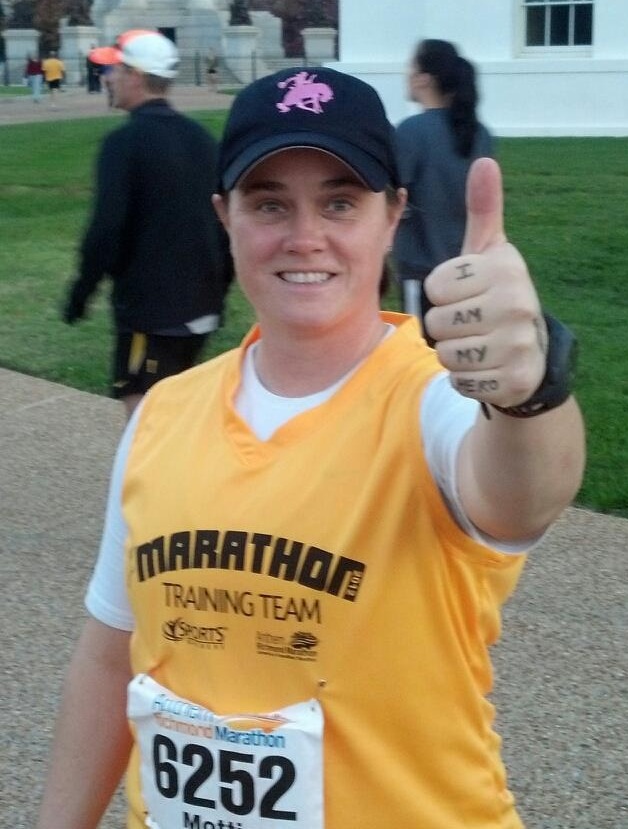
My very long point is, what is your motivation? What is your reason? What makes you not quit? Some times it’s very clear and some times we need to dig deep to figure it out. I saw a picture one time on line of a persons fist that had 4 words written on it; one word on each finger. It said “Be Your Own Hero”. I immediately fell in love the phrase and picture and adopted it for myself. I wrote on my hand “I Am My Hero” for the Richmond Marathon. When the doubts started popping into my head, I looked at my hand and thought of all those who could not do what all of us were doing that day. That is, and always will be, my reason why I will not quit.

What will make you not quit?

Redefining Social Networking by James Fabricant

Just as the words “computer” and “email” have become part of our every-day speak, the term “social networking” is simply part of our culture. And its obvious why – social networks are not new – humans are fundamentally gregarious and have always organized themselves into groups, forming strong and weak links. It’s the same behavior, just with new tools. Social media sites such as Facebook, LinkedIn and Twitter are by now so engrained into our personal lives that it is only a matter of time before they become part of our work lives. This revolution is already happening and is known as “social business” or “enterprise social networking.” The question for businesses is no longer being whether to implement it, but how.

Have you ever been swimming in the ocean only to find yourself being pulled in one direction from a strong current? No matter how hard you try, you can’t make any progress when swimming against the tide. Similarly, while social networking may have its issues in the workplace, and in particular security concerns, the key to success is not in fighting against it but, rather, figuring out to harness its potential while staying in control.  Just like swimming in the ocean, the best approach is to stop fighting and swim with the tide until you reach the shore.

Redefining Social Networking

When it comes to adoption, the initial resistance in the enterprise seems to be that social networking isn’t typically associated with working. To put it bluntly, there are laggards who think that if it’s “social,” it can’t be business. Changing the way we talk about it by using the terms “social business” and “enterprise social networking” will re-align the way we think about social tools in the workplace. In turn, the minds of those aforementioned laggards will begin to open and see that social can have a place in business.

Simplicity and Ease of Use is Key

Introducing a social business environment should make life easier, not more complicated. At the heart of social business is simplicity and ease of use, which is why there’s a huge problem with some of the really complex tools available. The ideas behind them are nice, and they certainly seem comprehensive enough to fulfill the needs of the enterprise, but if it’s too difficult to figure out and actually use, adoption will be low. The iPhone is a great example of simplicity done right. All of the basic functions that people want are readily available and incredibly intuitive– like making calls, checking email, downloading a new app, searching or texting. Because of that, it’s very popular. The same is true for rolling out a social business environment, it must be intuitive and secure or it will not thrive. 

Social is Enhancing, Not Fixing

Generally the enterprise is looking to solve a problem when adopting new technologies. This mindset works against social business adoption since it’s really not solving anything, per se. However, it is enhancing the way things already work, which is just as valuable. Think about the car – when Henry Ford invented the motor vehicle, we already had means of transportation via horse and buggy. But with the car, we can travel faster and for longer distances over a shorter time. Similarly, there’s always room to improve processes in the enterprise. So, in the enterprise, we can already communicate and collaborate, but there’s a way to do it more efficiently with enterprise social business. Research from McKinsey[1] shows that social business offers companies the potential to improve productivity of highly-skilled workers by 20 to 25 percent. It is simply taking a process that is already in place, and making it better.

Understanding Business Value

While social networking tools may be about enhancing rather than fixing, users will be slow to adopt these tools if they don’t understand the value. Organizations must first recognize the business value and communicate to users exactly how social business will advance current processes and activities. If a user knows they can save time or improve an existing process with the help of social tools, they will be much more inclined to get on board.

Serious Consideration

In light of these barriers, I believe that the enterprise is beginning to seriously consider integrating social business as part of its normal every day. Historically, the enterprise is very slow to adopt, often lagging about four to five years behind the consumer. Think about the Bring Your Own Device (BYOD) trend, for instance. Consumers started working on their own devices remotely without authorization, and once adoption got really deep within the organization, the IT department or CIO in charge realized it was not under control and lacked certain securities. This is how BYOD evolved to have more standard practices, and social business is following suite.

Already the enterprise is beginning to see how social business benefits such as structured conversation and simpler communication have value. These realizations are backed by research, too.  For instance, McKinsey reported that companies that use social media internally can reduce, by as much as 35 percent, the time employees spend searching for company information. They state that additional value can be realized through faster, more efficient, more effective collaboration, both within and between enterprises.

While this is undoubtedly compelling, we’re in the early stages of ROI and more quantitative results will likely be needed before enterprise social networking becomes the new norm. As businesses come to fully understand how social networks will propel their organizations forward, I predict adoption rates will surge. I look forward to the day when business and social meet and, until then, am certainly enjoying the ride.

Yoga For Runners By Baron Baptiste and Kathleen Finn Mendola

Although yoga and running lie on opposite ends of the exercise spectrum, the two need not be mutually exclusive.  During the course of an average mile run, your foot will strike the ground 1,000 times. The force of impact on each foot is about three to four times your weight. It’s not surprising, then, to hear runners complain of bad backs and knees, tight hamstrings, and sore feet.

The pain most runners feel is not from the running in and of itself, but from imbalances that running causes and exacerbates. If you bring your body into balance through the practice of yoga, you can run long and hard for years to come. Although yoga and running lie on opposite ends of the exercise spectrum, the two need not be mutually exclusive. In fact, running and yoga make a good marriage of strength and flexibility.

Striking a Balance

Runners who stick with running are most likely structurally balanced individuals who can handle the physical stresses of the workout with minimal discomfort. Yet, many runners don’t survive the imbalances that running introduces. Often, they suffer from chronic pain and are sidelined by injury.

A typical runner experiences too much pounding, tightening, and shortening of the muscles and not enough restorative, elongating, and loosening work. Without opposing movements, the body will compensate to avoid injury by working around the instability. Compensation puts stress on muscles, joints, and the entire skeletal system.

If you’re off balance, every step you take forces the muscles to work harder in compensation. Tight muscles get tighter and weak muscles get weaker. A tight muscle is brittle, hard, and inflexible. Because muscles act as the body’s natural shock absorbers, ideally they should be soft, malleable, and supple, with some give. Brittle muscles, on the other hand, cause the joints to rub and grind, making them vulnerable to tears.

Muscle rigidity occurs because runners invariably train in a “sport specific” manner—they perform specific actions over and over again and their focus is on external technique. This repetitive sports training or any specific fitness conditioning results in a structurally out of shape and excessively tight body.

Yoga’s internal focus centers your attention on your own body’s movements rather than on an external outcome. Runners can use yoga practice to balance strength, increase  range of motion, and train the body and mind. asanas move your body through gravitational dimensions while teaching you how to coordinate your breath with each subtle movement. The eventual result is that your body, mind, and breath are integrated in all actions. Through consistent and systematic asana conditioning, you can engage, strengthen, and place demands on all of your intrinsic muscle groups, which support and stabilize the skeletal system. This can offset the effects of the runner’s one-dimensional workouts.

Body Wisdom

In addition to physically counteracting the strains of running, yoga teaches the cultivation of body wisdom and confidence. As you develop a greater understanding of the body and how it works, you become able to listen and respond to messages the body sends you. This is especially important in running, where the body produces a lot of endorphins. These “feel good” chemicals also double as nature’s painkillers, which can mask pain and the onset of injury or illness. Without developed body intuition, it’s easier to ignore the body’s signals.

Awareness translates to daily workouts, too. You learn through the practice of yoga that each day is distinct, much like each run. Your energy levels fluctuate daily, even hourly, thus it’s important to have a sense of your reserves. The calmness you glean from yoga practice allows you to manage and economize your energy. You can learn to intuit where you are on a given day and what resources you have to give. Therefore, you don’t power drive through every workout mindlessly but rather respect your body’s limitations.

You can, however, maximize those varying energy levels by focusing on another nonkinetic aspect of yoga: relaxation. When you’re able to bring your body into a state of repose, you become more effective at using and conserving strength. If you’re in a contracted state—tight muscles, limited range of motion, chronic pain—your body requires more energy for all activities, running included. Relaxation allows you to burn energy at a more efficient level. The resulting increased vigor means a greater freedom of movement and ultimately, more enjoyment of all your physical activities.

Tension is the athlete’s downfall, and breath awareness is key to reducing it. Conscious breathing and pPranayama exercises, which soothe the sympathetic and parasympathetic nervous systems and relax the entire body, can be of great benefit to runners.

Many runners know that improving VO2 Max—aerobic capacity—is vital for running and racing success. Runners with a high VO2 Max have the capacity to pump large amounts of oxygen-rich blood to working muscles. Maximum oxygen intake is a crucial physiological variable determining performance and endurance for runners. With pranayama and asana conditioning, you can maximize the size of your pump and the quantity of fresh blood coursing through your body. A somewhat vigorous yoga practice can increase your oxygen capacity.

Pain Prevention

Even the most centered and relaxed runner can face injury—the bane of all athletes. Damage to a runner’s body is often the result of overuse instead of collisions or falls. It all comes back to—you guessed it—balance, symmetry, and alignment.

The body is the sum of its parts and impairment of one affects them all. A bad back is going to affect your ankles just as weak knees can throw off your hip alignment. For example, shin splints are the result of a seemingly minor misstep: an uneven distribution of weight that starts with the way the feet strike the ground. Each time the foot hits the pavement unevenly, a lateral torque travels up the leg, causing muscle chafing and pain up and down the tibia known as shin splints.

Knee pain, too, is related to other parts of the body. If the ankles are weak or the hips are not aligned, that can put strain on the anterior ligaments in the knees. Meant to work like a train on a track, a knee thrown off balance is equivalent to a train derailing. Due to constant forward motion, hip flexor muscles shorten and tighten and can cause hyperextension in the lower back. This constantly arched position holds tension in the back and can hamper the fluidity of hamstring muscles as well.

What does this mean for the runner with pain in his lower back? Or a painful heel condition? First of all, don’t ignore your body’s signals. Take a break when your body needs one. Learn to intuit when rest is appropriate. Secondly, start incorporating yoga postures into the warm-up and cool-down portions of your workout. Think of running as the linear part of your workout and yoga as its circular complement.

There’s no need to be sidelined by injuries and discomfort brought on by your running program. Chronic injuries can eventually self-correct through a gentle yet consistent yoga practice. Remember, your body is on your side. It has an inherent intelligence to bring about a state of equilibrium no matter how many times your feet hit the pavement.